Shop BITR Apparel Shop Now
We independently review everything we recommend. When you buy through our links, we may earn a commission.
XS-XL, 150 g for a size M
Dyneema base, Built-in pole quiver, Anti-bounce tightening system, Two 600mL locking flasks
May 14, $219
TAYLOR: Terms like “Revolutionary” and “GOAT” have been robbed of their identity. It’s a flat-out crime! Their broad use has casualized greatness and even elevated the mediocre to a point where it’s harder to give true credit to whom or what it’s due.
Imagine if Michael Jordan (undisputed GOAT) was put on equal podiums as these Insta-famous street ballers. Or if Kilian Jornet had the same title as someone who has set three hyper-local FKT’s. It just doesn’t make sense, and it muddies the water in our social media landscape, where everyone has the strongest and best opinions.
While all ends of the spectrum can be appreciated for their craft and skill, let’s just agree to reserve the status for who it rightfully belongs to. The real way to settle such disputes is to leave the discussion at the table and do the dang thing, right? That’s where many of these champions leave their mark.
I’m going to take a hard left in this conversation to how this relates to gear. I agree that this is a much more nuanced and arguable field. What works for me doesn’t always translate to everyone. However, in general, we BITR reviewers get the opportunity to try a lot of the best gear available, compare it, and share our take on it.
Innovation, quality, and, ultimately, confidence in use are hallmarks of the best gear. The list you and I come up with for GOAT gear will likely be slightly (or entirely) different. It’s personal… but at the same time, it’s not. Just as champions will eventually rise to become distinctive cream, we’ve noticed gear does the same. Can anyone say Vaporfly?
One of those pieces for trail running has been the Raide LF 2L belt. It quietly, yet decisively, changed my running experience. It’s the second-most-influential piece of running gear I’ve ever owned (the first is a portable water filter).
In true Raide fashion, they saw a gap and solved a problem better than anyone else has through innovation, quality, and confidence. Look around at group trail runs, races ranging in distance, and you’ll see that silver R in the small of many people’s backs.
They did the same in backcountry skiing with their packs.
Raide is infrequent in its releases because, as founder Kyle Siegel often hints, they want to solve a real problem in a way no one else has. They aren’t searching for problems to solve, though. These are the ones right in front of them, the problems they face as athletes, the problems they want to solve once and for all.
It’s personal. So, I’ve quickly learned that when something new comes out of the factory that has that unmistakable R signet, we’d better dust off what we’ve known about that particular problem or line of gear to compare. Case in point: the all-new Raide LF 5L pack.
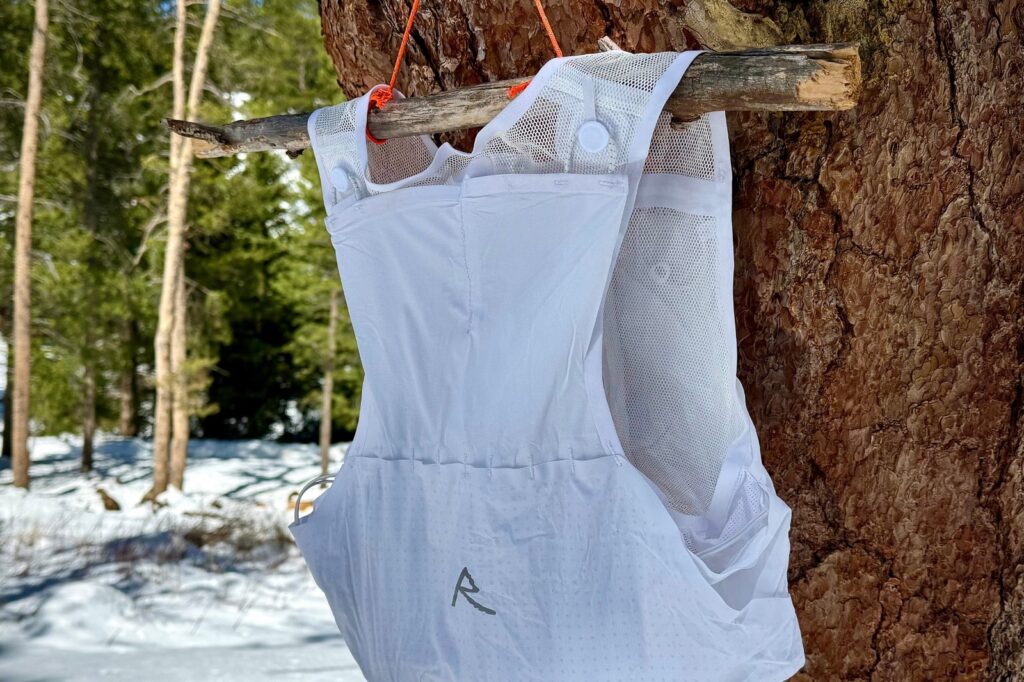
TAYLOR: When every piece the brand makes is brilliant, piggybacking off of success isn’t a bad thing. Just like Raide LF 2L’s thoughtful predecessors, the UL 1L belt (I use almost daily) and Trailtech Short, the LF 5L pack seeks to be a complementary item that can work wonderfully on its own and finds easy companions in the rest of the team.
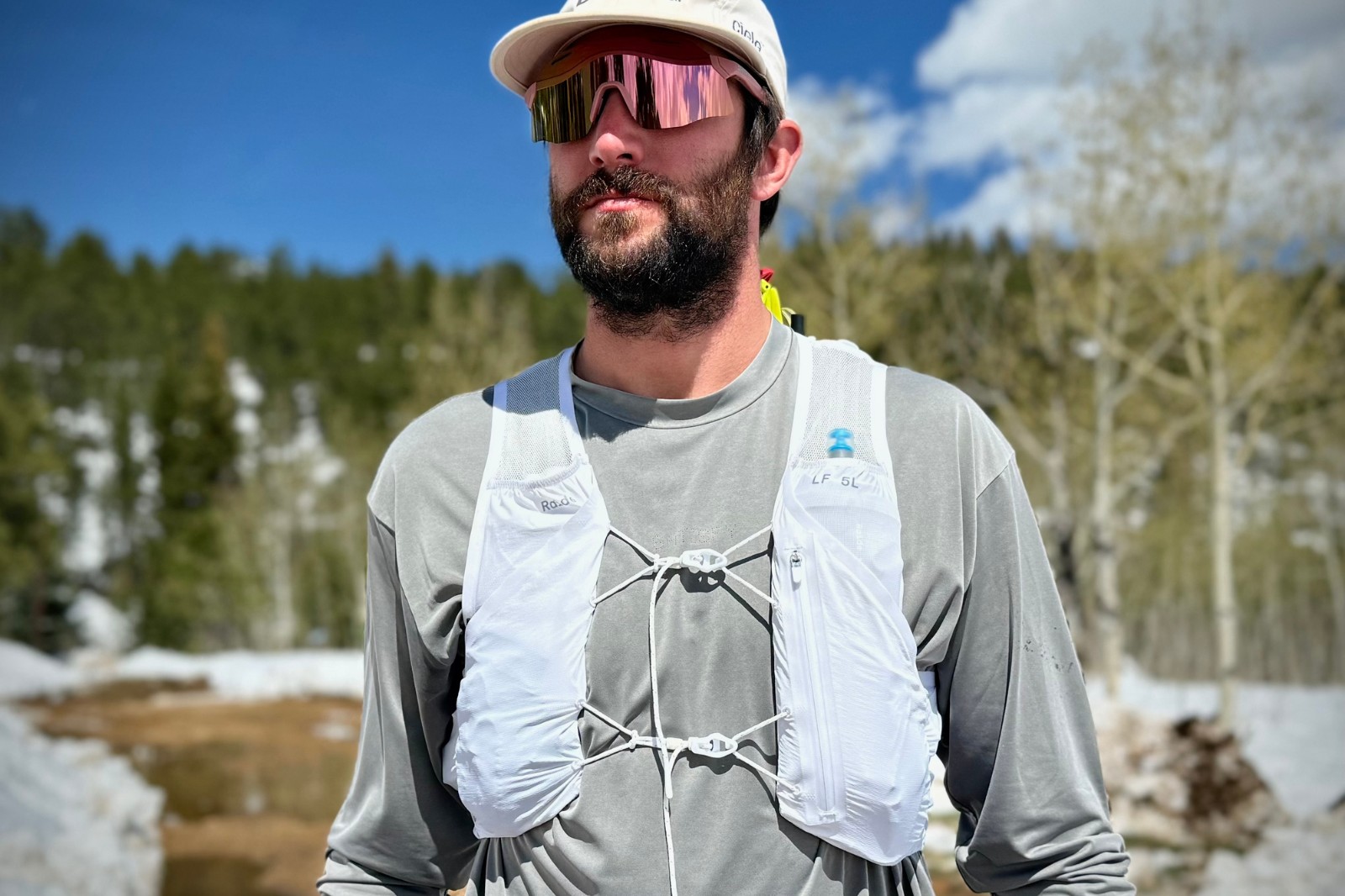
The design and performance of the LF 5L pack felt very “Raide” to me. What does that mean exactly? For starters, a clean, simple design that prioritizes function over everything else. By and large, there are only necessary components to keep the pack light, but a few details elevate the runner’s experience to a noticeable degree.
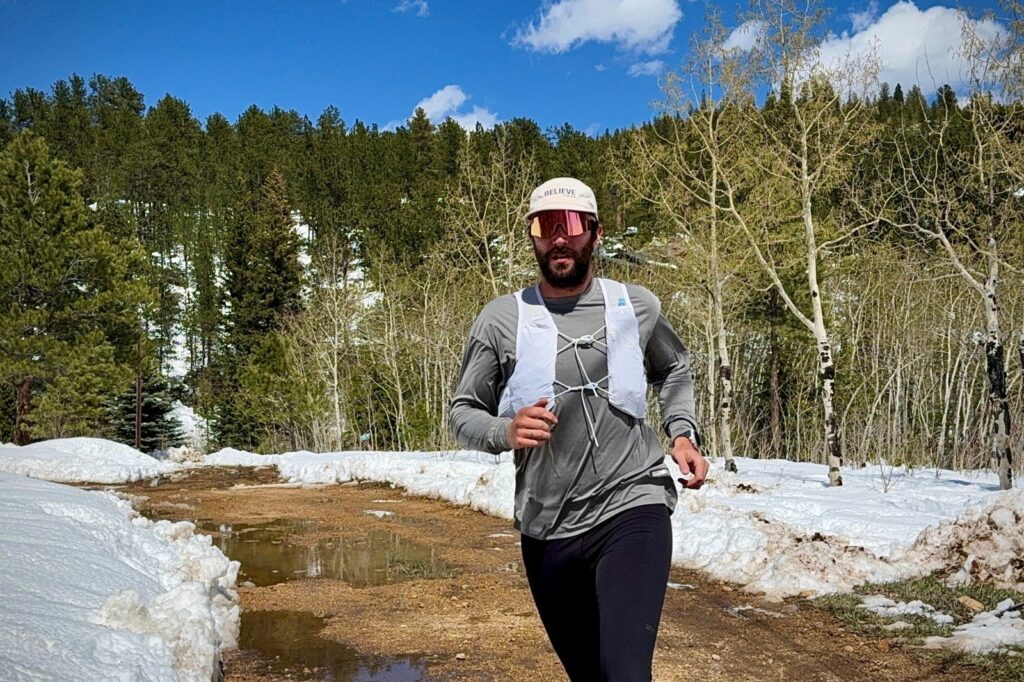
TAYLOR: I appreciate that Raide’s first trail running pack is a 5L pack. Many other companies use an 8, 10, or sometimes a 4-liter pack as their standard. As a belt-babe myself (yes, I’ll refer to myself as such from now on), I need a very good reason to bump up to a pack these days. This is true for long runs or race day.
The Raide LF 5L allows for more than double the capacity of any really effective belt out there. At the same time, it’s not so big to take away from the “light and fast” mentality.
Another good reason is that some races and adventures simply require more gear. If you head over to a UTMB race, you’ll need a pack. Go somewhere with a lack of water, you’d better bring a pack. Checking out some uncharted terrain, a pack is a solid option as well. So, again, the 5L pack really speaks to me as a nice size that fits the essentials for most outings.
TAYLOR: It’s not just about total capacity, though. Pocket layout and additional features matter just as much. Even some of our favorite fitting packs lack organizational features, which makes me even less inclined to reach for them.
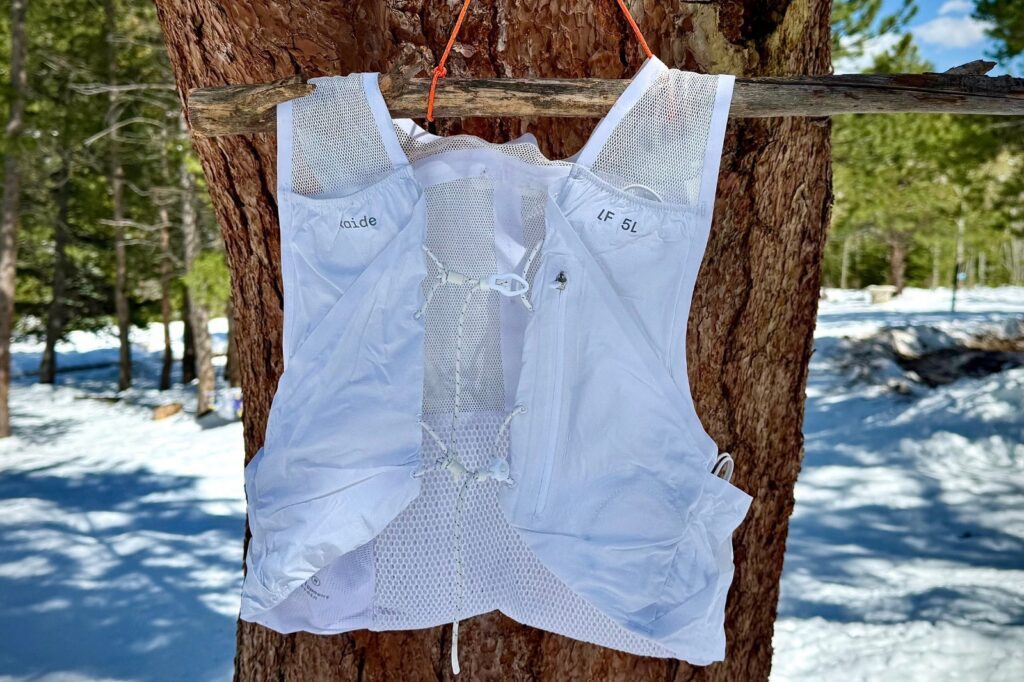
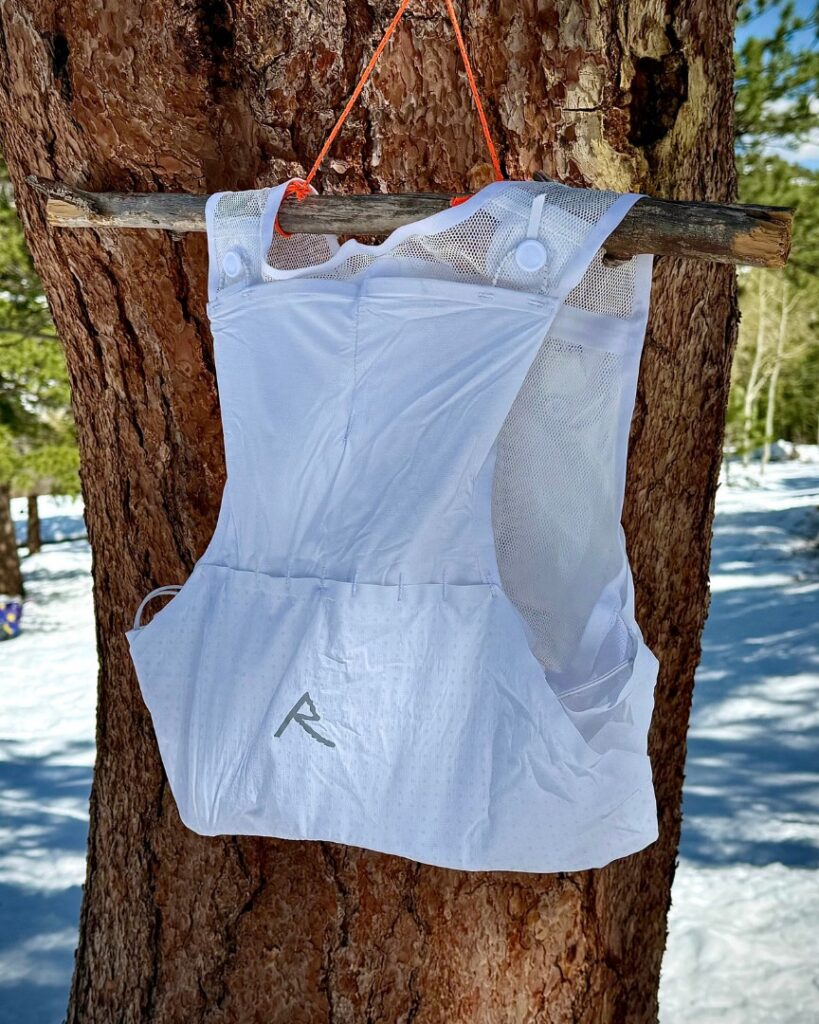
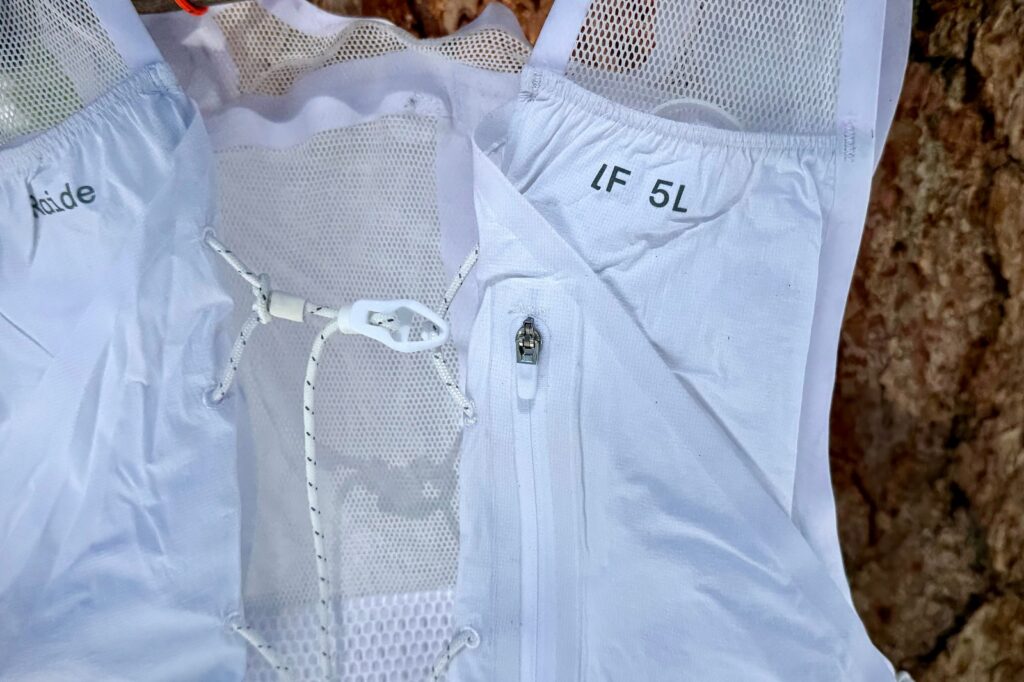
The Raide LF 5L pack contains two bottle sleeves (with signature 16oz HydraPak bottles and twist-locking caps), two pouch pockets, and a zippered pocket on the front. There are two more underarm pouches, a “lumbar” sleeve, two what I’m going to call “silo” pockets that join in the lower part of the pack, and an additional zipper at the bottom to access/adapt the rear pouch as needed.
Here’s an example of what I could fit comfortably and run with no bounce: Two 16oz flasks, phone, an Insta360 Ultra camera, gels, poles, a waterproof jacket, a pair of gloves, a buff, a pair of microspikes, and I could have added another flask and fuel if desired.
All of these pockets are overlaid with a stretchy yet form-holding mesh that expands when loading up the pack. As unflattering as the visual is, I think of a frog’s vocal sack and how it expands and retracts but never really loses tenacity. I found that all the pockets securely carried a variety of goods, without bouncing even within the pockets themselves.
The only real issue I had was in the rear pockets. Since they only close via a unique hook-and-loop system, a headlamp slipped out of the pack when I bent over to tie my shoe. Another minor problem was getting bottles in and out of the designated pockets. It’s an intuitive process, just not the smoothest transition.
As for a smaller hiccup, I found a flaw while carrying poles. Since there is only a light mesh between your back and the pack (no cushion in the upper portion), I did feel my poles dig into my back a little. Over time, that could pose an issue for comfort, but the poles did carry extremely securely in this system.
Speaking of, if you prefer blurring the lines between trail running and mountaineering, the aforementioned zipper pocket extends the silo-style pocket to accommodate an ice axe, keeping it safely and securely in your pack.
Shop The Pack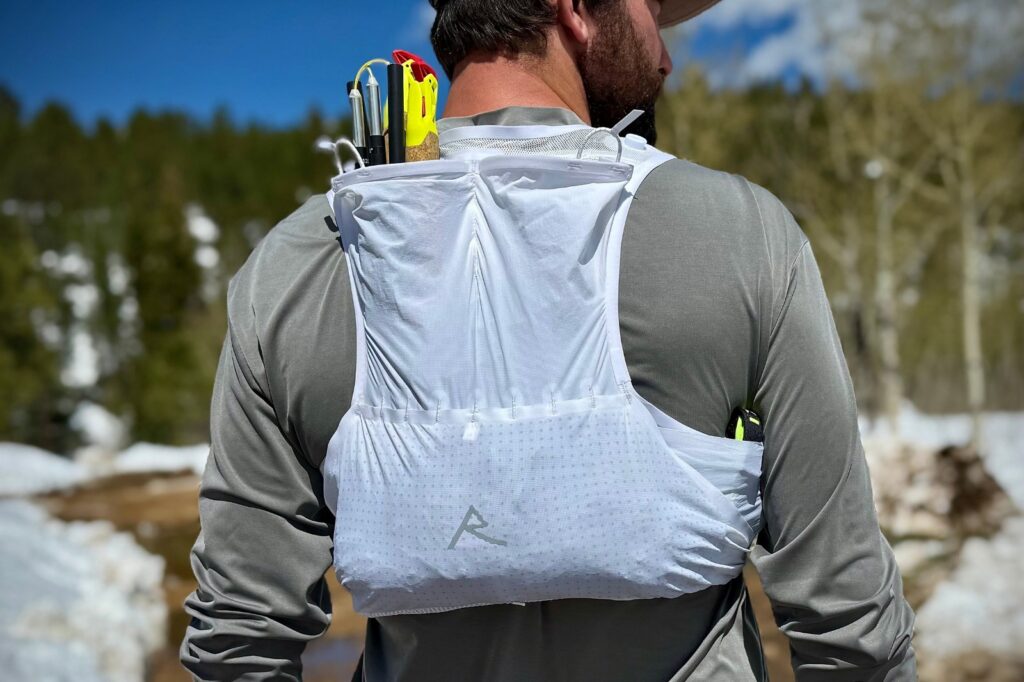
TAYLOR: Whether you are carrying full capacity or not, it makes no difference with the Raide LF 5L. It delivers the no-bounce promise better than any pack I’ve experienced. Really, the only knock I could give was when I had a size too big. When I resized it, it even handled the ultimate test of carrying two full bottles up front with very minimal bounce. Even so, it was even better in this scenario than the Tantrums Crest 6 — which has been our favorite lightweight pack as of late.
The leg up comes from a touch more structure via a Dyneema mesh and a slightly broader construction across both the back panel and the chest straps. It’s very “vest-like” as opposed to the typical pack design, and the base layer Raide used is very breathable. There’s also strategic mesh padding in the lower half of the back panel, similar to that found in the Raide LF 2L belt (foam). It acts as both a cushion and an anchor point for the pack.
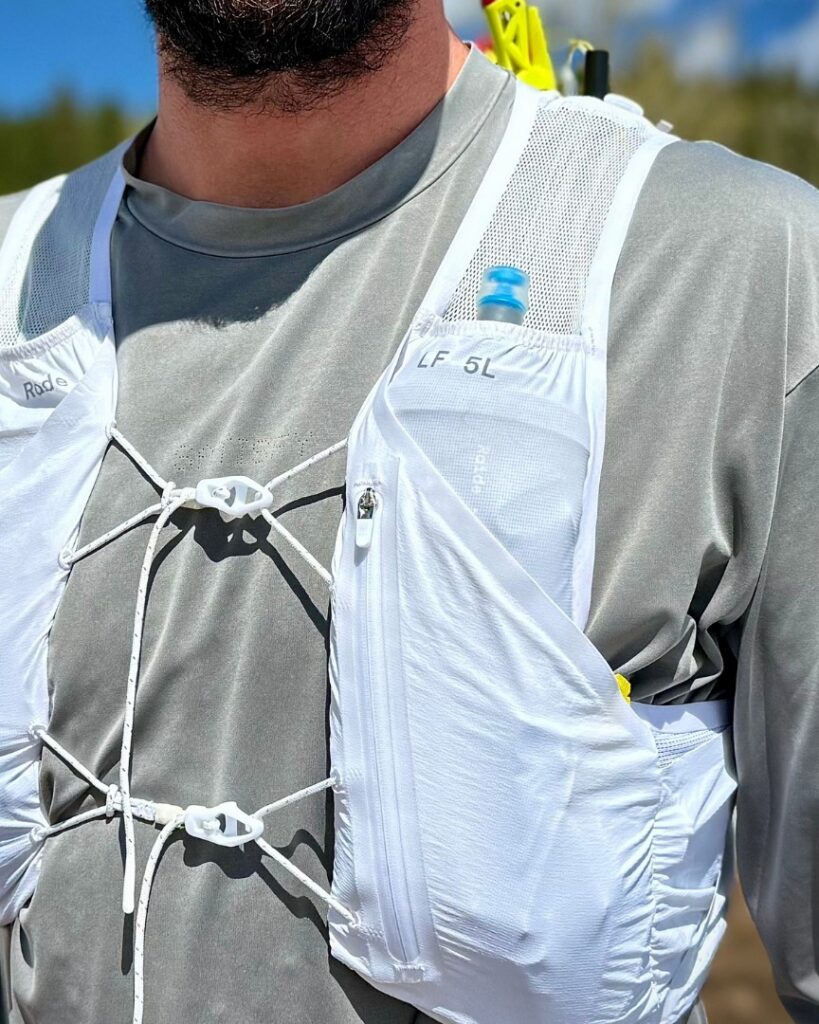
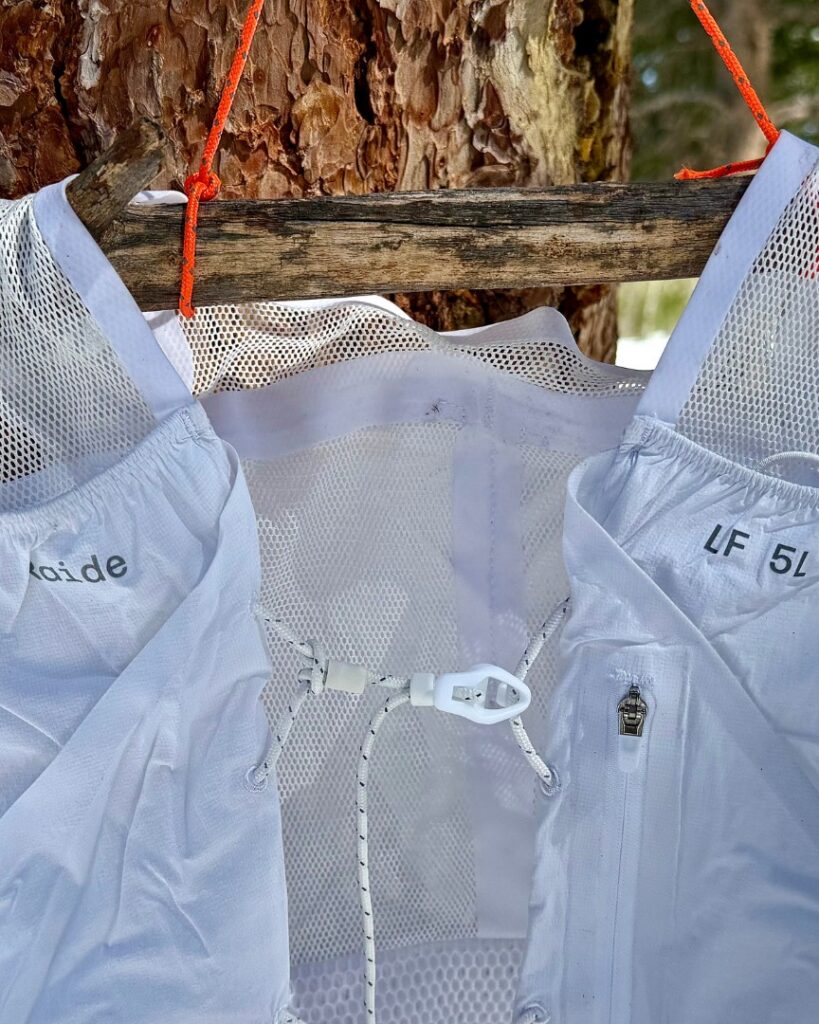
I have to admit, I wasn’t initially a fan of the chest strap system. It seemed almost too simple. There’s no way to adjust it vertically, and the ends of the straps just hang there.
I’ll also be the first to admit that the placement of the straps was optimal. They crossed centrally across my chest, and the lower one was just above my diaphragm, so there wasn’t a constricting feeling around my body. Also, I never once noticed the strings flopping while running. So, take that for what it’s worth.
Chafing is always a question with packs, but I had zero issues with this one. I typically have trouble along the sides of my neck where the straps come in contact or under the arms. Neither was on my radar with the Raide LF 5L. All seams and edges are finished with a soft heat-adhered tape — just another of the little quality things that start to set a pack like the Raide LF 5L apart from the rest.
Also, I’m a size medium in most shirts and packs, and that worked perfectly as my guide for the Raide LF 5L, too.
Shop The Pack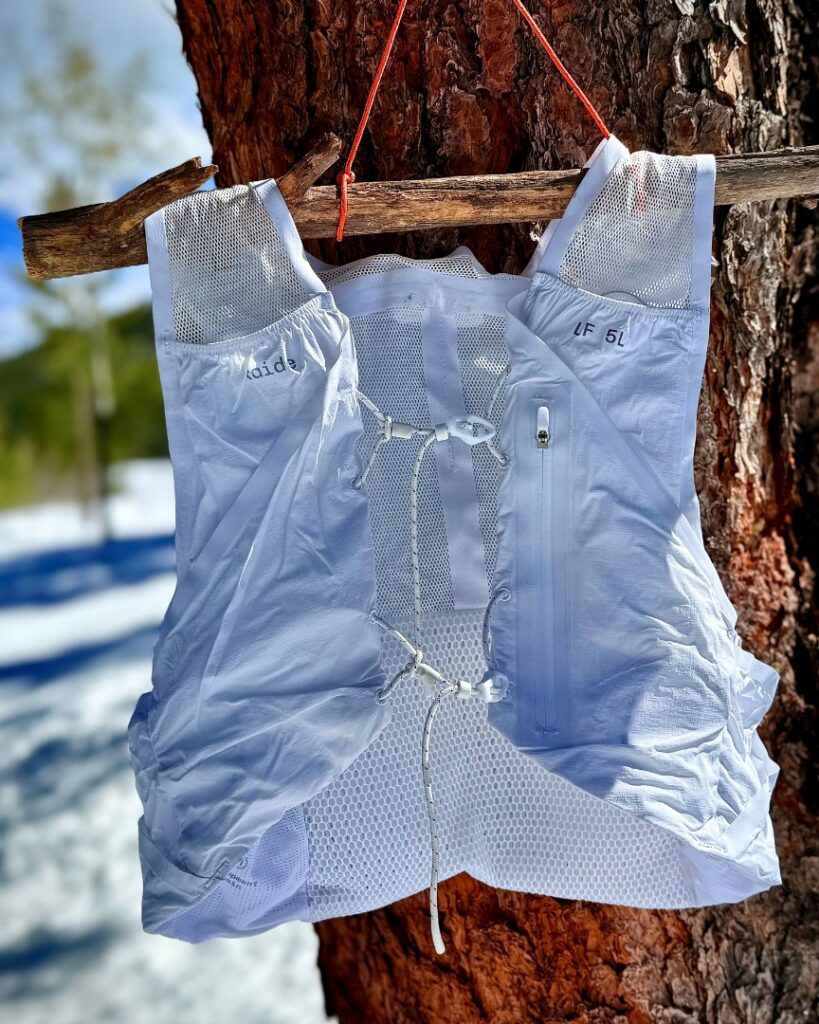
TAYLOR: Again, in a crowded space, it’s hard to gain traction, but it’s the little things that eventually win out.
First, let’s go back to reinforced seams and edges to discuss durability. This is one of the lightest packs on the market (especially at this capacity). While it’s the same weight as the North Face Summit Series 5 vest (5.71 oz/ 162 grams) and slightly heavier than the Tantrums Crest 6 pack (5.19 oz/ 147 gr), the build quality and durability edge out both of them.
We’ve mentioned the variety of pockets. Most, even a sleeve pocket on the lower back, are common. Having small rubber grippies on the inside is uncommon. This is where I almost always stuff a light jacket, and I found confidence in knowing it’s going to stay put. It’s like having personal tree frogs holding your gear in place
Just above that, the silo pockets allowed for compartmentalization and the ability to carry larger items like poles and an ice axe without getting creative or attaching a quiver. A simple shoulder bungee and clasp system allowed the load to be secured really well by closing each silo individually. Unless you plan on getting inverted, there should be no bouncing or losing items.
Like the chest strap system, I’ll admit that I wasn’t a fan and was sure that my shoulders would feel the plastic clasp, but no. It proved to be another one of those simple and well-functioning features that blended in and never bothered me.
Shop The Pack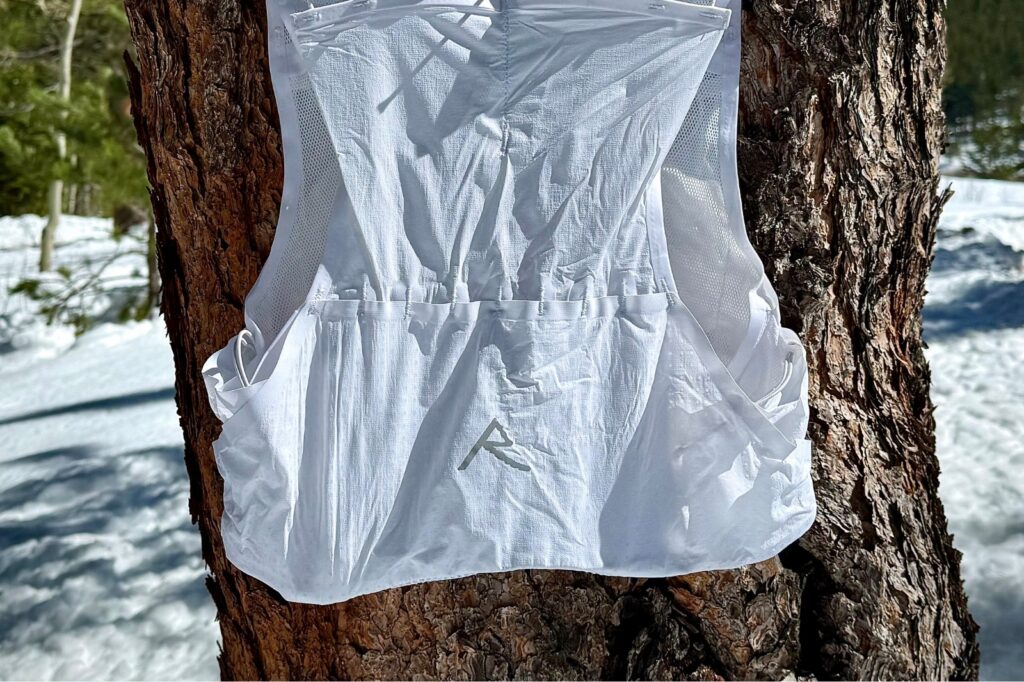
TAYLOR: So, the question, then… Is the Raide LF 5L pack revolutionary?
No.
But it is certainly worthy of GOAT talks. Listen, there have been many companies trying to do what Raide does. There are a lot of really good options out there already, and this pack doesn’t quite set itself apart from the masses as the LF 2L belt did.
For what it’s worth, the Raide LF 5L will be my new go-to pack because it already combines many of the features of my favorites. It is among the lightest in the game, carries any amount of goods with less bounce than any other pack out there, has a top-shelf build quality, and it has a few little touches that set it apart even further if you’re a mountain athlete, especially.
You can pick up the Raide LF 5L vest on May 14, 2026, for $219.
Shop The PackHave something to say? Leave a Comment
Sign in or create a free account to comment. You'll come right back here.
Sign in / Sign up


Taylor Bodin is a trail and ultra runner living in Estes Park, Colo., with his wife and daughters. As the head of the Dirt Division at Believe in the Run, trail running is pretty much the only hobby he can manage right now and loves it. Every so often, he will pop off a race or FKT attempt because competition is pure and the original motivator for him getting into running anyway.
More from Taylor




Great review, as always, Taylor! Looks like pricing is now live at $219.
Can’t wait to try mine out!
Looks really enticing! Thanks for such a detailed review. Any thoughts on how it compares with the Rab Veil 6L?
James
Great read, will there be a YouTube review?