Shop BITR Apparel Shop Now
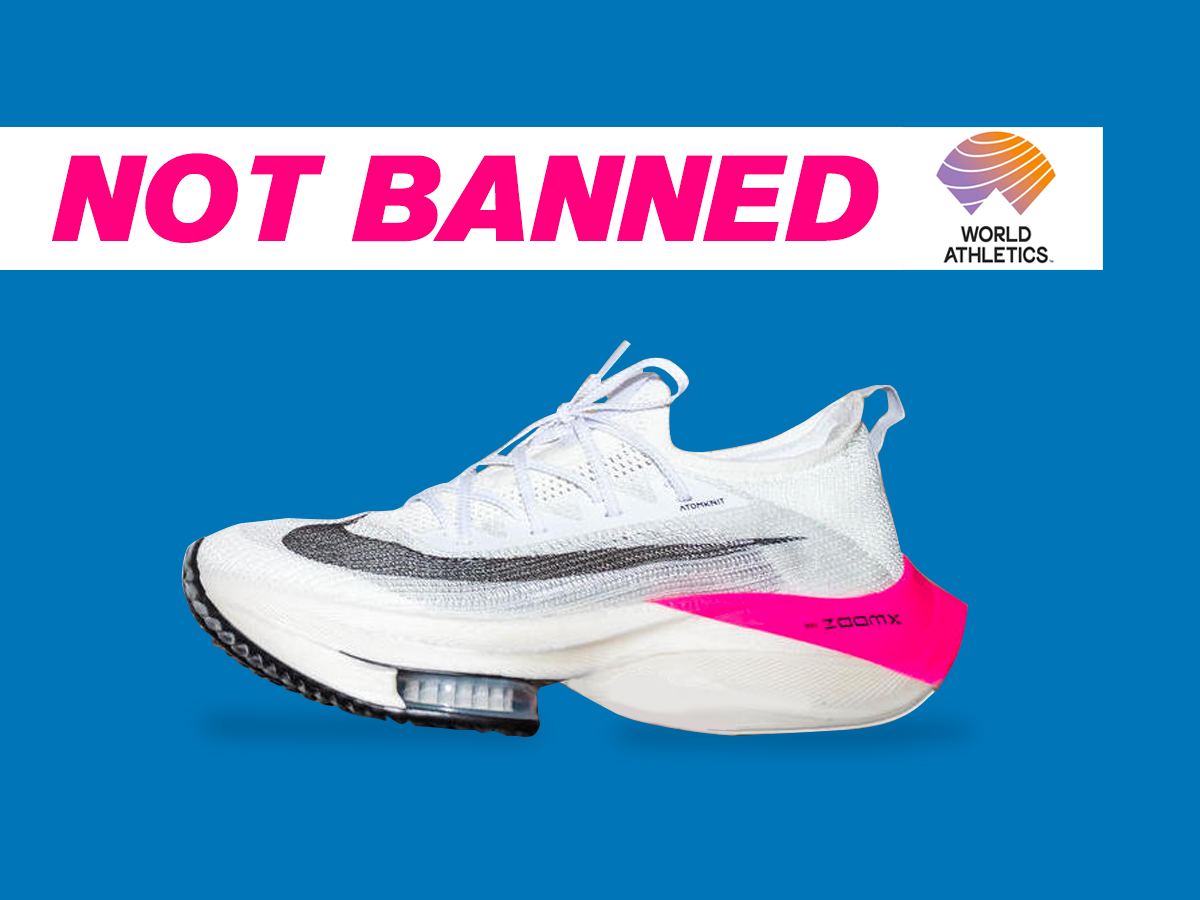
Nike haters, your day has arrived.
Today, World Athletics (formerly IAAF) has announced an amendment to its rules regarding running shoes worn in competition, specifically regarding carbon-plated and high-stack shoes that are not widely available to the general public.
If you’re in any way engaged with running culture, you’re aware that over the last couple months, speculation has run rampant over whether or not the carbon-plated Nike ZoomX Vaporfly NEXT% and yet-to-be-released Nike AlphaFly will be banned from competition.
No doubt, records and times have fallen lower and lower since Nike first introduced the original Vaporfly 4% in 2018. Indeed, independent scientific studies have proven that the shoe gives a competitive edge. Consequently, questions regarding fairness of sport abound, especially as other shoe companies scramble to close an ever-widening gap between their shoes and Nike.
Look at the start line of any marathon and behold the tidal wave of runners strapped into the Nike Vaporfly on race day (including non-Nike sponsored athletes with blacked-out versions). Each and every one of them striving to harness that extra energy returned from the foam and plate combo underfoot. As this scenario became the standard race scene over the last two years, it seemed inevitable that a rule would be instated to level the playing field.
So today, the hammer came down.
No longer shall Nike rule the marathon with its prototypes of carbon layer cake and king-sized foam midsoles. Mark January 31, 2020, as the day the playing field was leveled.
Except, not really.
While swoosh antagonists and armchair running enthusiasts are rejoicing in the streets, Nike is sitting comfortably in its throne. And, spoiler alert– it will be for some time.
For starters, this entire saga is about the best PR campaign any company could ever ask for. When was the last time your friend who has only run a 401K (poorly) asked you about a marathon racing shoe?
Meanwhile, most people are caught up on these three components of the new World Athletics ruling:
If you don’t think Nike has these areas covered, you are naïve at best, and an ignorant fool otherwise.
Nike has been developing the AlphaFly for some time. Recently, more and more versions have been popping up all over the world, signifying that full-scale production is not far off. Mark my words, a version of the AlphaFly will be ready for wide release within four months of Tokyo. Yes, that means it would be available in March. Keep in mind that there is quite the gray area around the term “wide release.” We’d certainly like to see World Athletics outline that further.
Secondly, we can confirm (via Nike) that we were wrong in our original patent dissection of the AlphaFly. While patents showed the potential for a three-plated shoe, the final AlphaFly will only have one plate. Leaked prototype versions of the shoe that you are now seeing only have one plate.
Stack height? Big deal. The Nike Vaporfly NEXT% is– coincidentally enough– exactly 40 millimeters. The AlphaFly stack height will come down, and I’m guessing production models are already pared back to the World Athletics limits.
Olympics aside, today’s World Athletics ruling gives Nike a huge advantage over its competitors for years to come, which is this– sponsored athletes from other companies will no longer be able to race in prototype shoes, which is the only way of closing the gap with the AlphaFly in competition.
While, yes, every company has a high-cushioned, carbon-plated racer coming out in 2020, they are still objectively far behind the NEXT%, and years behind the AlphaFly. You can read a Wired or New York Times article about this, but none of those writers have run a step in the competition’s models. Trust us when we say it’s not even close, especially in the marathon distance.
The ruling also raises some questions for Nike’s competitors and the Tokyo timeline. Namely, Saucony, whose star marathoner Jared Ward is a favorite to make the United States trio heading to Tokyo. If he’s to race in the Saucony Endorphin Pro (carbon-plate racer), then the company is going to have to fast-track its release date (now slated for June 1) by at least two months.
Then there’s HOKA One One, which sponsors top-marathoner Scott Fauble, another favorite for the United States Olympic team. They’ve been tight-lipped about a rumored Carbon X Rocket prototype coming in around the 6 oz. weight, which will undoubtedly feature carbon plate technology and high stack height (duh, it’s f-ing HOKA).
Brooks is fine, as the Hyperion Elite comes out in the middle of February and meets all requirements. New Balance may have some work to do as current production models of the FuelCell TC seem to exceed the 40-millimeter stack height, even though that’s the training model and a purported RC (racing model) is on the way. (By the way, this measurement is taken from the inside middle of the heel, 12% in from the back of the shoe, to include the insole or any other kind of insert.)
All this to say, there is no level to this playing field, at least not in the short term. The World Athletics “ban” is simply some pre-Tokyo window dressing to quell the dissent of those dissatisfied with Nike’s advanced technologies.
None of this changes the fact that Nike is king shit of shoe island, for now and for the foreseeable future, fairness and bans be damned.



Robbe is a podcast host and reviewer at Believe in the Run. He loves going on weird routes through Baltimore, finding trash on the ground, and running with the Faster Bastards. At home in the city, but country at heart. Loves his two boys more than anything. Has the weakest ankles in the game.
More from RobbeSign in or create a free account to comment. You'll come right back here.
Sign in / Sign up